Enter your Email


Powered by FeedBlitz

Monday, November 13, 2006

Flu shot linked to extremely rare side-effect

In extremely rare cases, getting vaccinated against the flu can trigger
a potentially debilitating neurological disorder known as Guillain-Barre
syndrome, say Canadian researchers, although they stress their
finding should not make people shy away from getting their shots.

Uh huh...well well...very interesting to see that Canadian Medicine is now recognizing something negative about the flu shot. The neurological disorder caused by the flu shot affects 10 in 1 million people. Or, 1 in every 100,000 recipients. Considering that approximately 10 million doses of the flu vaccine are distributed in Canada, this equates to approximately 100 people who will suffer from this neurological disorder.

"We know that the vaccine can prevent 80 to 90 per cent of deaths
in people over 65 years of age in (long-term care) institutions,"


If this is true then why does the government roll out over 10,000,000 vaccines each year?

Anyway, you be the judge for yourself and your family on whether or not you will go for the flu shot. If you stay healthy, a slight cold or flu really isn't that bad considering the negative effects (aside from Guillain-Barre).

http://www.cbc.ca/cp/health/061113/x111330.html

Friday, November 10, 2006

Sorting Through The Issues Of Organic Milk

In 1993 the US dairy industry changed dramatically. That year the FDA approved the use of a genetically-engineered form of bST, sparking a controversy that has persisted over the last thirteen years, leading to law suits and disputes over public health and safety. Many organically-minded consumers switched over to "hormone-free milk," only to later learn that there was no such thing. What is rbST anyway, and how does it affect cows? The intent of this article is to sort through the issues concerning rbST, so that you can make an informed decision about the milk you buy.

Somatotropin (bST) is the hormone which stimulates milk production and is naturally produced in a cow's pituitary gland. In the 1950s scientists first developed a recombinant form of this hormone, hoping to use it to treat children suffering with dwarfism. The injections had no effect whatsoever on the children, and the experiment was deemed a failure. Scientists concluded that some hormones were species-specific, meaning they only affect members of their own species. In the 1980s scientists had a new use for the synthetic hormone-inject cows with it to stimulate greater milk production. Studies began to see if such a theory would work.

The use of rbST (which is also called rbGH, Posil, or Bovine Growth Hormone) is often misunderstood. Misinformed individuals think that farmers who use the synthetic hormone use it 100% of the time with their entire herd. This is simply not true. rbST is used in synch with a cow's natural lactation cycle. Soon after a cow gives birth she reaches her peak milk production-a state called freshening. Sometime thereafter, her production steadily declines until she goes dry. The average cow produces milk 306 days out of the year. rbST is used toward the end of the freshening stage, to prolong higher milk yields later into the cycle. If a cow is already at peak production, rbST will not yield more milk. Neither does the hormone affect all cows equally. While the hormone boosts production in the average cow by 10-15% per year, some cows may not be affected at all. Dairy farmers therefore use the hormone on about a third of the herd at a time.

The Controversy

In 1993, amid a storm of controversy, the FDA released its conclusions regarding the use of rbST in dairy cows. None of the studies performed detected any significant difference in the milk of cows which had been treated with the synthetic hormone versus those who had not. Even if the hormone was passed in higher concentrations in the milk, which it wasn't, the FDA asserted that rbST would have no affect on humans. Therefore, the FDA did not require farmers using rbST to label their products.

When some organic farmers voluntarily labeled their milk as "hormone-free" or "bST-free," the FDA sued, saying that all milk contained natural hormones, and that the voluntary labels misled the public into thinking organic milk was healthier. Appropriate wording was finally agreed upon, and organic dairy farmers now inform their consumers that products have been made using milk from cows not treated with rbST. As a result of the law suit, organic farmers must also state that the FDA has found no difference in the milk produced by treated and untreated cows.

Their findings would have packed more power, had not three voices joined the resistance. Richard Burroughs, who played a lead role in the FDA review process, was shocked at how few tests the agency was running. When his questions threatened to slow down the approval process in the late 1980s he was fired. Alexander Apostolou was also pressured to leave the agency when he publicly stated that "sound scientific procedures for evaluating human food safety of veterinary drugs have been disregarded." It should be mentioned that neither Burroughs nor Apostolou objected outright to the drug, but advocated more thorough testing. Their concerns were not appreciated. They were joined by Joseph Settepani, a chemist in charge of quality control for veterinary drug approvals. After testifying at a public hearing that a systematic breakdown in testing had occurred, Settepani was stripped of his duties as a supervisor and sent to work in a small experimental farm. During this time numerous letters were sent by FDA workers expressing their concerns about the inadequate testing, choosing to remain anonymous because they were afraid of retribution.

Other countries, experiencing the same backlash, made different choices. To date, Canada, Europe, Japan, Australia, and New Zealand have barred the use of rbST in their dairy cows. While their decision may be pitted more in politics than in human safety, (increasing the milk supply would drive down the price, forcing taxpayers to spend more money on farmer subsidies), at least two Canadian studies have yielded questionable results. In the first, it was suggested there may be a very rare sensitivity to food products from rbST-treated cattle. A subsequent study in 1998 found increased risks in animal safety. Treated cattle were 25% more likely to suffer from mastitis, 18% more likely to be infertile, and 50% more likely to go lame.

Whether or not milk from rbST-treated cows is really any different, the controversy has resulted in a steady market for organic dairy farmers. Since 1993, the demand for organic milk has increased 500%, and at present, the demand is greater than the supply. While the FDA is unlikely to back down, it appears dairy farmers are responding to their market. Last week on the shelves of the dairy case I noticed traditional farmers are now offering their own milk products-produced by cows untreated with rbST. Francesca Black

Monday, November 06, 2006

Halloween Sugar (comic)

"I actually sketched out four Halloween comics -- and scrapped them all -- before coming up with this one. The challenging part is demonstrating the negative health effects of sugar without having to explain them. Of course, I don't think sugar has ever turned anyone green, but it does make kids crazy, aggressive and more than a bit frightening. It also rots out their teeth, as illustrated here.

Sugar consumption also seems to disproportionately affect young boys vs. young girls. That's why this comic shows the young boy out of control from sugar consumption while his sister remains calm and cool-headed.

Halloween is the strangest holiday of them all (and they're all a bit strange, mind you). Children dress up as dead people then run around collecting free candy that makes them obese, diabetic and neurotic. Halloween has been completely taken over by corporations, who depend on the holiday for as much as 50 percent of their annual sales of candy products, most of which are made from various metabolic poisons such as hydrogenated oils and high-fructose corn syrup.

Adults actually condone all of this and serve as tour guides, leading their children around to strangers' homes, collecting whatever they hand out, and actually allowing their children to eat it! At any other time of the year, adults handing out something to little children would be arrested, but on Halloween, it's all normal.

It all goes to show you the power of reframing. Dress up like a terrorist and run around ringing peoples' doorbells on any other day of the year, and you'll get arrested and shipped off to Guantanamo. But do it on Halloween and everybody smiles and compliments you on the authenticity of your costume.

For all you adults reading this: If you're going to participate in this demented holiday, at least have the decency to give out something healthy. Nut mixes or trail mixes are a good idea. You can also go green on 'em -- give the little kids tiny bunches of wheat grass and I guarantee they won't bother you next year. Just don't stuff the kids with any more sugar, artificial colors and hydrogenated oils. They're already being poisoned by everybody else on the block. There's no need to add to it.

And for goodness sake, parents: Don't let your children participate in this mass poisoning event. You wouldn't let your kids eat anything handed to them by strangers on any other day of the year. Why allow it on Halloween? Dressing up in costume is great fun, but do it with friends and family, and skip the candy route.
http://www.NewsTarget.com/020897.html

"Think before you pink": Critics say breast cancer ribbons may be little more than marketing gimmicks

(NewsTarget) Breast cancer is the second most deadly cancer of all and is increasing in prevalence, so it is no surprise that "pinked" products promising to help fight the disease are so popular, but some critics say the movement is just another marketing gimmick and consumers should "think before they pink."

The "shop for a cure" is promoting pink ribbons on a variety of products from pet food and frozen dinners to knives and cars, but Breast Cancer Action group's Executive Director Barbara Brenner said that consumers need to stop and think about how much of their money goes to fighting the disease, which charity will get the money, and what it will be used for.

"Any company can put a pink ribbon on anything,'' said Brenner, whose advocacy group runs www.ThinkBeforeYouPink.org. She adds that some companies only make small donations or cap their donation amount at a fixed sum, no matter how much the consumer purchases. Other companies' promotions can have consumers spending the same amount to send in lids or labels to earn charity money as the companies end up donating. October was Breast Cancer Awareness Month, so some companies just put the popular pink ribbon on their products to "promote awareness," while donating nothing to treatment or research for a cure, Brenner says.

Brenner suggested that consumers bypass these companies and write a check directly to local charities that are doing good work.

The largest group devoted to breast-cancer research, the Susan G. Komen Foundation, asks that dollar amounts of donations, minimum guaranteed donation, and the covered time period be printed on the label of products sold by its corporate partners, as per the Better Business Bureau Wise Giving Alliance guidelines.

As much as $33 million is expected from said corporate partners, notes cause marketing manager Krissy Barker, who added that the companies deserve publicity if they are making real contributions to the cause. However, she said that consumers should read labels closely before buying pinked products or making donations.

"Some of the companies touting pink ribbons on their products give absolutely nothing to breast cancer research" said Mike Adams, creator of the "Education, Not Medication" program for breast cancer prevention awareness. "Even those companies that make a donation are focused almost exclusively on a slash-and-burn treatment approach to cancer, using toxic chemotherapy treatments and radical surgical procedures.

"Almost no one is teaching women how to actually prevent breast cancer through sensible nutrition, avoidance of exposure to toxic chemicals and regular exercise," Adams said.

Education Not Medication


"The emphasis on breast cancer "screening," and the circus of holding breast cancer awareness months is, of course, all about recruiting more women into a system of treatment that generates profits for drug companies. Using fear-based tactics of recruitment (like telling women, "You'll die in six months if you don't undergo chemotherapy..."), the breast cancer industry manages to corral women of all races and ages into treatments that actually harm far more women than they help."
If the statement above doesn't shock you read this:
"...for every one woman helped by breast cancer screening, ten were harmed through false diagnosis or unnecessary treatments that devastated their health."
This is according to a study by Researchers at the Nordic Cochrane Center in Denmark where they studied 500,000 women to determine the results of breast cancer screening programs.

Find out what a list of 18 things that cause cancer and 22 things that can prevent it. Click here to read the article written by Mike Adams.

Sunday, November 05, 2006

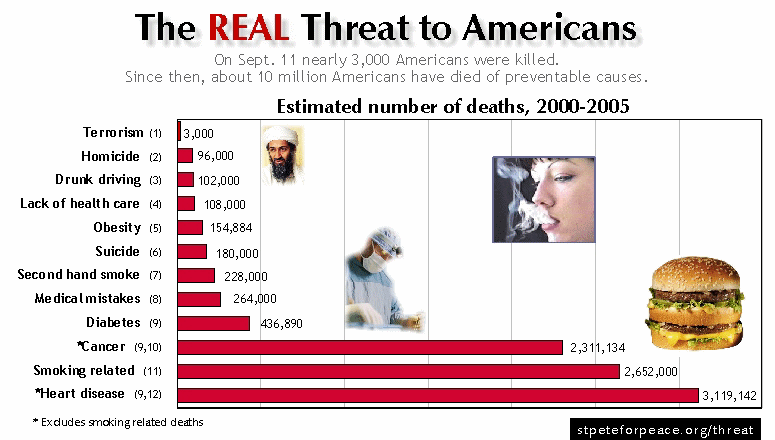
The REAL Threat to Americans

An interesting chart I came across containing data from credible sources about the number of total deaths in America and their causes.

It gives us all a great view to what the causes of death are in America. Consequently, I would figure the same statistics to be very similar for us in Canada (except for the terrorism part).

Truthfully speaking, I'm kind of getting tired of all this 'terrorism' talk. So I'll shut my mouth up now.

http://stpeteforpeace.org/real.threat.html

Friday, November 03, 2006

Water or Coke

A funny article I just came across containing statistics of water and coke. It's an interesting read and I'd really love to find out if some of the statistics are in fact true and where the statistics came from. I know it's on a joke website, but still...
(I will have to admit that I already saw the episode of Mythbusters which busted many of the myths surrounding Coke)

I do know for a fact that a good chunk of the population IS dehydrated. No one seems to drink water anymore...maybe because it's more expensive than gasoline.

http://www.thatwasfunny.com/water-or-coke

Thursday, November 02, 2006

An apple a day keeps the doctor away...true?

I stumbled across this article written by Dr. Gerard F. Judd, a Ph.D., chemist, researcher for 18 years and Professor of Chemistry for 33 years. If this is entirely true, I would have to personally say that he is indeed an expert in his field...well...assuming that he is a respected person in his fields of interest and that he is in sane mind to boot.

Dr. Judd writes a very interesting article which contradicts everything to which the dental industry stands for. Is the dental industry just a 'business' in which they create disease just so that they can profit from it? I guess a great analogy would be the theory that all computer viruses are written by the companies which also create anti-virus software applications. If you truly think about it, what would happen if the anti-virus companies DID get rid of all the computer viruses in the world? What would they have to 'fight' against if they succeeded? Would they still need to be in business?

So, please read this article and let me know what you think.

http://gerardjudd.com/summation.htm

Monday, October 30, 2006

Reset your sleep clock...

If you haven't already done so, please update your clocks. Yup. North America just changed time again while you were asleep last night (early Sunday morning) in order to save on energy costs. It used to be earlier in the month of October until the US government decided to change it some time last year. In order not to confuse the life out of the Canadian population (not to mention the potential catastrophic events that would occur in the business world) the Canadian government decided to follow suit.

Luckily in the fall time we get that 'extra' hour of sleep because we set our clocks backwards. In the spring we set our clocks forwards, hence, we all lose an hour of sleep.

If you were listening to the news and have changed your clocks accordingly but still can't get your sleep schedule right, MSN has a great article on how to reset your sleep clock.

http://health.msn.com/centers/depression/articlepage.aspx?cp-documentid=100147511

Good night and sleep tight!

Saturday, October 28, 2006

The Secret DVD for Canadians

Hey all you Canadians! I just discovered a place in Canada that you can buy The Secret DVD!

I have heard of many people that have tried to purchase the movie from the main website (www.thesecret.tv) but it was in US funds and had $5US shipping and would also take a couple weeks to arrive. Also, I have heard of many people who were unable to successfully purchase the DVD using their credit card online for some strange reason.

Well, wait no more! Just go to www.inspiredlife.ca and click on The Secret logo at the top right of the screen. You can pay online using your credit card through Paypal. Don't worry, you don't have to have a Paypal account anymore to purchase through vendors that use Paypal as their payment processor. It's quick, safe and easy.

For only $35CDN you can own a copy of the DVD. I also heard through the grapevine that The Secret Book and Audio CD will be available in December. I'll keep you posted! Just keep coming back to this site (and don't forget to tell your friends!)

What is The Secret? Watch the preview trailers below one at a time to find out.

This website is best viewed with Mozilla Firefox.
It truly is fast and secure.